
Kleberg County Release Meaning
“Released” means the named custodian has ended its hold. It does not always mean the person walked into the community. The Kleberg County Detention Division identifies bond or fine payment, time served, and transfer as ways someone leaves its custody. Bond may end the jail stay while the criminal case continues. Time served means the required jail term has been credited or completed. A transfer moves the person to another county, TDCJ, a federal agency, or immigration custody.
That distinction controls the next search. A community release creates a jail event record and may appear on the sheriff's rolling list. A TDCJ transfer calls for the state offender search. A federal or immigration handoff calls for the relevant locator. Dismissal, sentence completion, parole, and probation can affect the court or supervision record, but they should not be inferred from a charge or bond amount. Confirm the release type or receiving agency with the custodian.
| Exit type | What it means | Next record |
|---|---|---|
| Bond or fine | County custody ends; the case may continue | Jail release event and court docket |
| Time served | Required county-jail time is satisfied | Jail record and sentencing court |
| Transfer | Custody changes agencies | Receiving custodian's locator |
| Parole or mandatory supervision | Prison confinement ends under supervision | TDCJ and Parole Division records |
| Discharge | Sentence or supervision obligation ends | Corrections history or release certificate |
Kleberg County Release Record Fields
The official Kleberg County 48-hour release roster ties a person to one booking event. Its cards show a booking photograph or placeholder, name, booking number, release date and time, booking date and time, charges, displayed bond, and a profile link. Charges and bond can change after a court appearance. The sheriff directs case-number, charge, and correct-bail questions to detention staff, so the card is not a final court disposition.
| Field | What it establishes |
|---|---|
| Name and booking number | Identity tied to a particular county booking |
| Booking date and time | When the jail intake event was recorded |
| Release date and time | When county custody ended for that booking |
| Charge and bond | Roster information that may later change in court |
| Booking photograph | Image associated with the county booking |
| Release type or receiving agency | Durable custodian field to request when the web card is unclear |
The web list is a convenience view, not the full archive. A valid event drops away as the 48-hour window rolls forward. For older cases, ask for the booking sheet or jail card, release timestamp, release type or disposition, receiving agency if transferred, and booking image. Existing records are better request targets than questions that require staff to create a new explanation.
The official roster screenshot shows how timestamps, bond, charges, and images appear together.
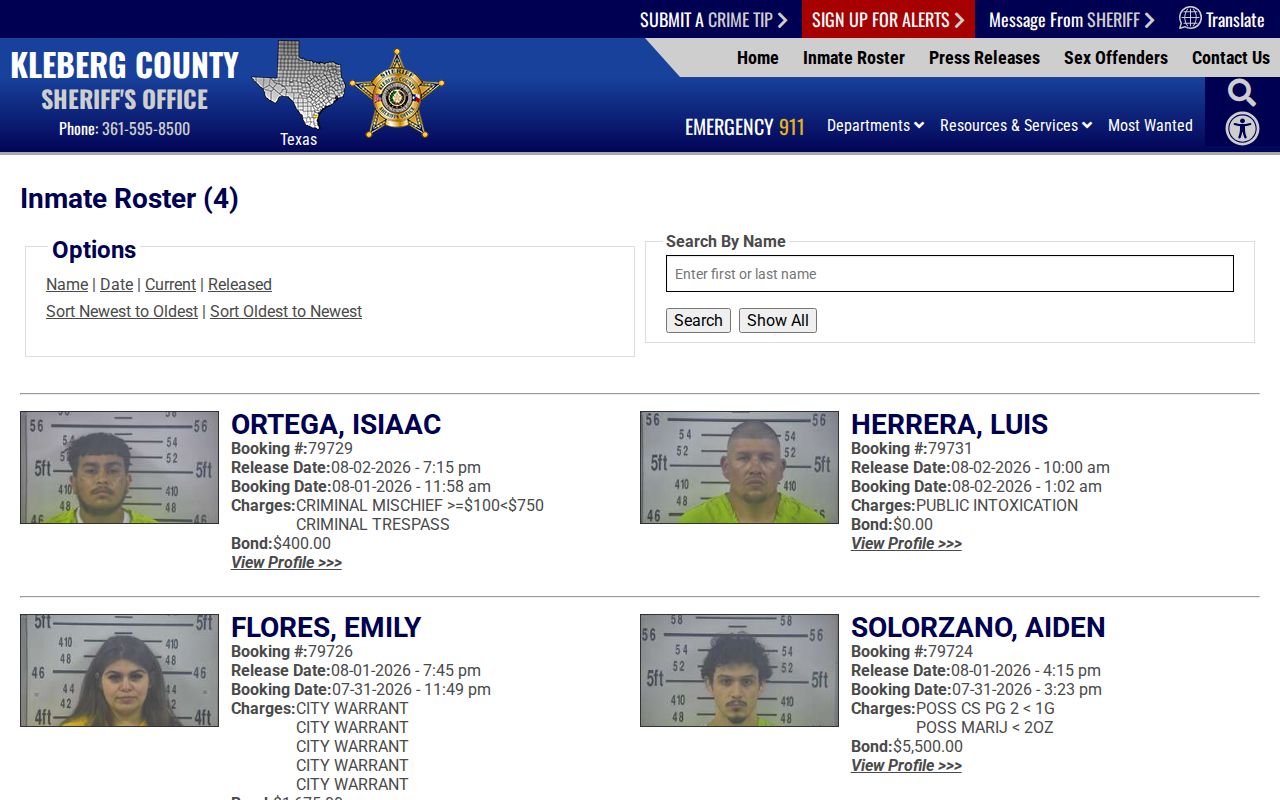
The live card should be matched to a booking number and then checked against the lasting jail and court records.
Request Kleberg County Release Records
Texas Government Code chapter 552, the Texas Public Information Act, provides the general request framework. Direct a county jail request to the Kleberg County Sheriff's Office and describe the existing record with enough detail to locate it. The detention center is at 1500 E. King Avenue, Kingsville, TX 78363; the jail number is 361-595-8500. Research did not identify a special online release-record form or a guaranteed local turnaround, so do not promise one.
- Give the full name and a narrow booking or release date range.
- Add the booking number when known and name the booking sheet, jail card, release event, or photograph sought.
- Ask for the release date and time, release type, and receiving agency field if a transfer may have occurred.
- Request an estimated charge before copies are produced if cost matters.
- Compare the response with the court docket when the disposition is important.
Texas law permits redaction or withholding when an exception applies. Juvenile material, confidential identifiers, medical details, active-investigation material, and records affected by a court order may be limited. An expunction can require destruction or return of covered records. Nondisclosure restricts public access to certain criminal history but is not the same remedy. The order and originating custodian determine the effect; a missing web card does not prove either remedy occurred.
The Act generally calls for prompt production under the circumstances. When an office seeks an Attorney General ruling to withhold responsive material without a prior determination, Government Code section 552.301 sets ten-business-day and fifteen-business-day procedural deadlines. Those deadlines are not a promise that every Kleberg County release request will finish in ten days. The office may ask for clarification under section 552.222, and copy, labor, or electronic-work charges may apply under state cost rules. Inspection is ordinarily free unless programming or manipulation is needed. Ask for a written estimate and a cited legal basis for any withheld part, then keep the response with the original request.
When Kleberg Bond Release Finishes
A magistrate sets bond in warrant and new-arrest matters, and payment or court authorization begins the release process. Physical exit can still take from minutes to several hours, according to the sheriff's jail page. The printed release timestamp is therefore stronger proof of completed county custody than a receipt, approval, or expected pickup time. Bond release is not dismissal. The court case can remain open, and displayed charges or bail can change after later court action.
No official source publishes fixed daily exit times or a designated waiting point. Families should confirm the event with detention staff instead of relying on an estimated processing interval. Sentence-discharge timing follows separate Texas rules and exceptions, while bonds and transfers can occur outside that ordinary daytime framework.
Find Kleberg County Released Inmates
Start with the last known custodian, not a broad name search. The sheriff separates the current roster from the official recent-release list. Presence on the current roster reports county custody. Presence on the release list reports a recent event. Absence from both is inconclusive because the event may be older, the spelling may differ, another agency may hold the person, or the web system may not yet reflect the change.
- Check the sheriff's current-versus-release choice and compare exact name and booking details.
- Use the release timestamp to isolate the newest day through Jail Releases: 24 Hours.
- For a sentenced state prisoner, search TDCJ by name or number.
- Check County Clerk or District Clerk court records for the case disposition.
- Use VINE as an alert and lead, then verify with the reporting custodian.
- For older county events, request the jail record directly.
A released person normally leaves the live jail roster. Use the recent-release view or durable jail record instead.
The sheriff's choice screen states the actual recent-release window.
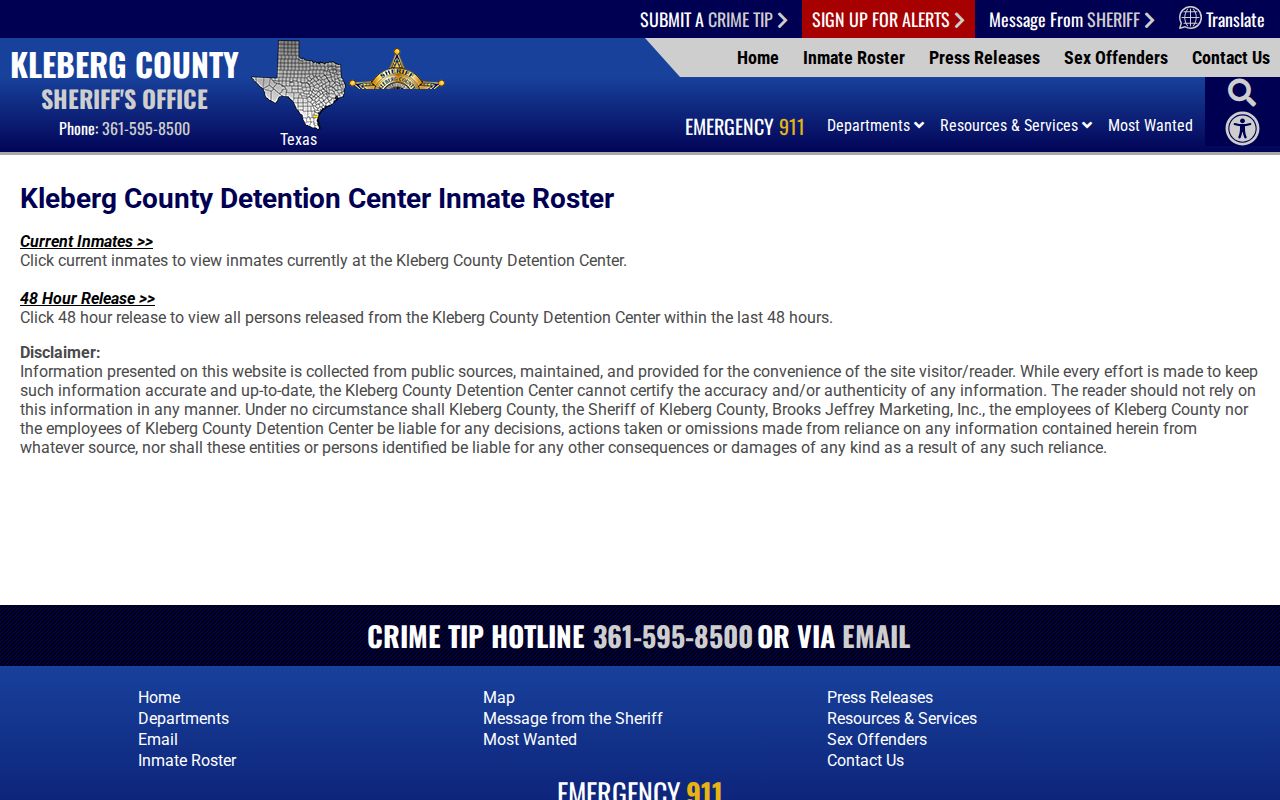
It prevents a current-custody roster from being mistaken for a historical release search.
Kleberg County 48-Hour Releases
Kleberg publishes one rolling 48-hour list, not separate official 24-hour and 72-hour feeds. The release times are precise enough for readers to create a 24-hour subset. A 72-hour inquiry has a real gap for hours 49 through 72, which must be filled through the jail record and court case rather than an aggregator. Sorting and name search are available, but no separate official update cadence is stated.
The sheriff also offers an alert signup described as daily or as-needed 24-hour booking and release information. Treat an alert as notice to check the custodian record. It is not a substitute for a timestamped release card. Older references to MobilePatrol are historical; current Kleberg app coverage was not verified.
TDCJ Released Offender Search Limits
The TDCJ offender search covers people currently incarcerated in a TDCJ facility and selected status fields. It is updated on working days and may be at least 24 hours old. A live result can show unit, projected release date, maximum sentence date, parole eligibility, and review information. It is not a complete public archive of former state prisoners, so disappearance from the live search does not establish the exact discharge event.
| Search field | Use |
|---|---|
| Last and first name | Broad match; compare carefully |
| TDCJ number | Direct state corrections identifier |
| SID number | Texas state identification number |
| Sex and race | Optional narrowing fields |
For history after a person drops from the live search, use TDCJ's no-charge incarceration-information email route or a formal Public Information Act request. Ask for incarceration history, release date, and release certificate or record. The email page says photographs are not supplied. A projected date is only an estimate; Projected Release explains why it changes.
The official search form shows the accepted name and number paths.
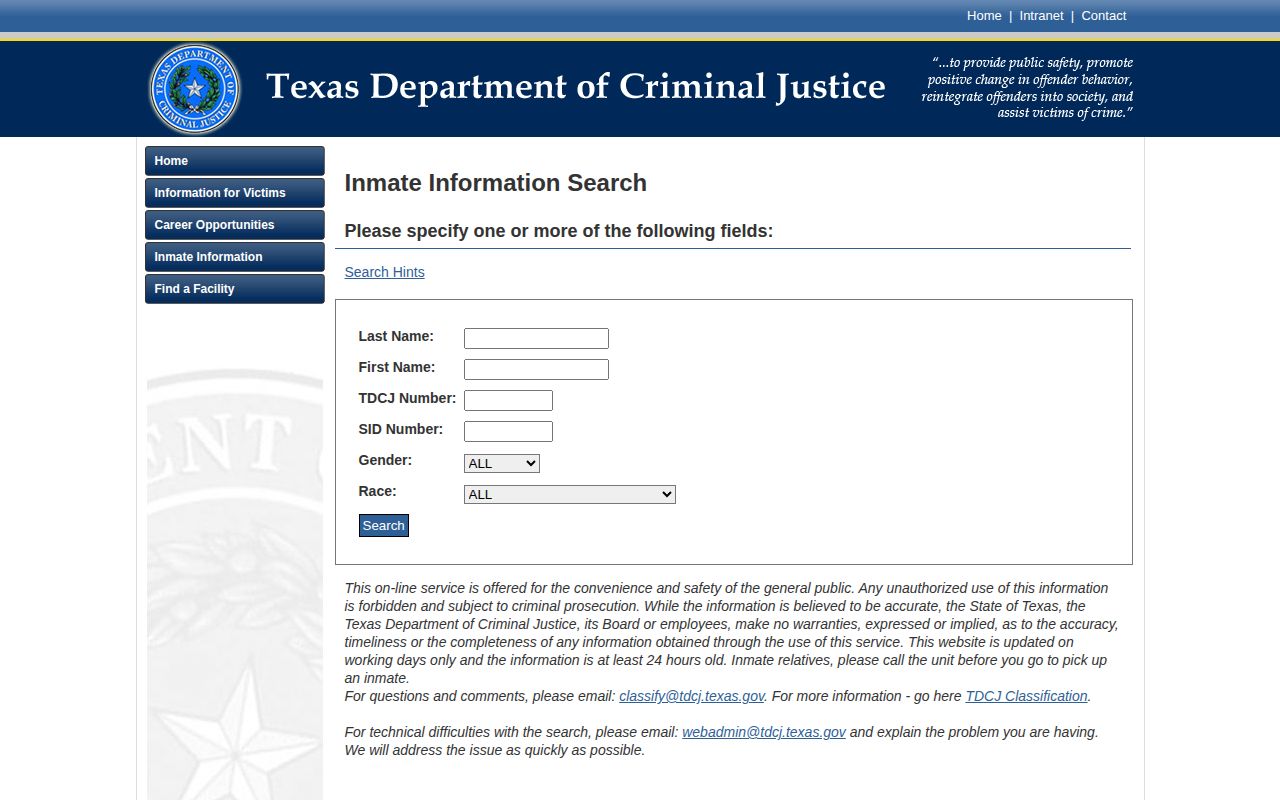
A match identifies a state corrections record, not a Kleberg County jail release by itself.
Kleberg Release Cases and Fees
The Kleberg County Clerk links county criminal records to Texas Online Records and lists a $10 criminal search fee, $1 per page for copies, and $5 for certification. Felony and district matters belong with the District Clerk. A no-result in the County Clerk route may therefore reflect the wrong custodian, not the absence of a case.
Court disposition and jail release answer different questions. A jail timestamp proves the county custody event. The docket can show dismissal, plea, sentence, bond action, or later orders. Neither should be used to guess the other. Search by case identifiers when available and confirm whether the matter is county-level or district-level before paying for a clerk search.
Kleberg County Release Supervision
Parole is supervised release from a prison sentence. Probation, called community supervision in Texas, is a court-ordered sentence served in the community. The TDCJ Parole Division administers state parole supervision, while the Kleberg County Community Supervision and Corrections Department handles local adult probation. One office should not be asked to confirm the other's cases.
A parole approval is not proof of physical exit. Verify the TDCJ status and release record, then use the appropriate office for current supervision. The Probation & Parole page separates those paths and provides the Corpus Christi District Parole Office route for Kleberg releasees.
Kleberg Release Alerts and Transfers
Texas VINE searches participating reporting-agency records and can register notifications. A release or custody-change message is a lead. Record its time and agency, then confirm a county event with KCSO or a state event with TDCJ. A transfer alert does not necessarily mean community release, and a no-result can stem from spelling, timing, participation, or confidentiality.
Federal cases require the BOP Inmate Locator. A historical BOP result may show a release date, but “not in BOP custody” does not explain why custody ended or whether supervision continues. Immigration custody uses the ICE Online Detainee Locator, which is a current locator rather than a criminal release archive.
Kleberg County had a 287(g) jail-enforcement agreement with ICE dated July 31, 2020. That historical agreement does not prove present participation or a current handoff. It does explain why a county exit can be an immigration transfer. Confirm the receiving agency from the jail event and then check the current ICE system.
Getting Home After Kleberg Release
Paisano Transit, operated by Kleberg County Human Services, provides general curb-to-curb transportation with published fares and weekday and weekend hours. In-town trips ordinarily must be booked by 4 p.m. on the prior day. It is not documented as on-demand discharge transport, and no official source confirms a jail-door stop.
A practical plan requires two confirmations: ask the jail about the likely exit process and ask the transit provider whether a pickup point and schedule are feasible. Since release processing can take minutes or hours, a fixed ride should not be based only on bond payment time. No official family waiting area has been published.
Kleberg Jail Release Turnover
A Texas Commission on Jail Standards report published in July 2022 lists Kleberg County jail capacity at 160 and an average daily population of 100 for its measurement snapshot. These figures are not annual bookings or releases. They describe capacity and average population at that report point. The rolling recent-release list measures turnover events over two days, so it should never be treated as the jail's full population or historical archive.
Kleberg County Release Facility
The Kleberg County Detention Center is the county's principal booking and detention facility. Local police, university police, state officers, constables, and sheriff's deputies deliver arrested people there. No TDCJ prison, BOP institution, or dedicated ICE detention center was identified within Kleberg County, so none should be mistaken for a second local jail.
Community release from the detention center appears briefly on the sheriff's rolling list. After that, use the requested jail event and court case. For a transfer, identify the receiving custodian and continue in its system. This one-facility map prevents an arresting police department from being treated as a long-term detention facility.