
A dated alert should be preserved with the agency name and exact status wording. Those details let KCSO, TDCJ, or another custodian identify the event without guessing which database produced it.
Kleberg VINE Timing Checks
KCSO's recent-release display lasts about 48 hours, while VINE depends on when a participating agency sends its update. The systems need not change at the same moment. When their wording differs, note the access time for each and call the jail booking line instead of choosing whichever result seems newer. A later written release sheet provides the durable county event record.
VINE does not decide the legal meaning of release. Bond can end a jail stay while a case continues. Parole can end confinement while supervision continues. Transfer ends one facility's control but begins another's. The court docket, jail release type, TDCJ history, or receiving-agency record supplies those distinctions. Keeping event type apart from custody status prevents an alert from becoming an unsupported claim about dismissal or final discharge.
Do not rely on one delivery route for an important notification. Register each practical channel offered, keep the account current, and retain the service contact. If the person enters another county, TDCJ, BOP, or ICE system, repeat the search in the new source rather than assuming the first registration follows every later custodian.
Kleberg County VINE Coverage
Texas VINE through VINELink is a custody-information and notification service for participating jails and corrections sources. It is strongest as a forward-looking alert system. A user searches one person, selects a source record, and registers for changes such as release, transfer, escape, or return to custody when those events are offered. The service can show information from a county jail or state corrections source, but the research did not find an official statewide list guaranteeing every Kleberg County or TDCJ event.
Read the source agency before interpreting the status. A result naming the Kleberg County Detention Center concerns county custody. A TDCJ result concerns a state prisoner held somewhere in the Texas prison system. VINELink does not replace the federal BOP Inmate Locator or the ICE detainee locator. A transfer between custodians is a custody change, not proof that the person returned to the community.
Search a Kleberg County Inmate
Begin at the live Texas portal and search only enough detail to distinguish the intended person. Names can collide, so a familiar name alone is weak proof. An agency label, identification number, age, and custody location can help separate candidates. If the portal produces several people, open each plausible record and compare the source rather than assuming the first result is correct.
- Open the Texas VINELink search and choose the custody or offender search offered on the live screen.
- Enter the person's name or available identification fields. Try a careful spelling variation if the first search has no match.
- Review candidate records and select the one whose descriptors and reporting agency fit the person.
- Read custody status, location, event wording, and event time as separate fields.
- Save the reporting source, then verify a release with that jail or corrections agency.
If the match identifies KCSO, compare it with the sheriff's current and rolling released lists. Older county events require the booking and release record. The broader Kleberg County released-inmate search path is on the home page, including court and transfer fallbacks.
Kleberg County VINE Result Fields
A VINELink result describes what a participating source reported. Field labels can change as the interface evolves, so preserve the exact wording and time shown instead of converting it into a stronger claim. “Out of custody” does not by itself explain bond, time served, transfer, or discharge.
| Field | What it establishes |
|---|---|
| Reporting agency | The jail or corrections source responsible for the event. |
| Custody status | The source's current reported state, such as in custody or released. |
| Facility or location | The reported custodian or placement, when displayed. |
| Person or offender ID | An identifier useful for separating people with similar names. |
| Event type and time | The reported change and timestamp, not a court disposition. |
| Notification option | The available path to register a phone, text, email, or app alert. |
A scheduled or projected state date is future-oriented. It does not prove physical exit. TDCJ says its live offender search covers people currently incarcerated in TDCJ and that web data is updated on working days and at least a day old. Once a former prisoner leaves that current search, request incarceration history or release information from TDCJ rather than treating a missing live result as discharge proof.
The official Texas VINE landing screen shows the state entry point. View the live Texas portal before relying on its controls.
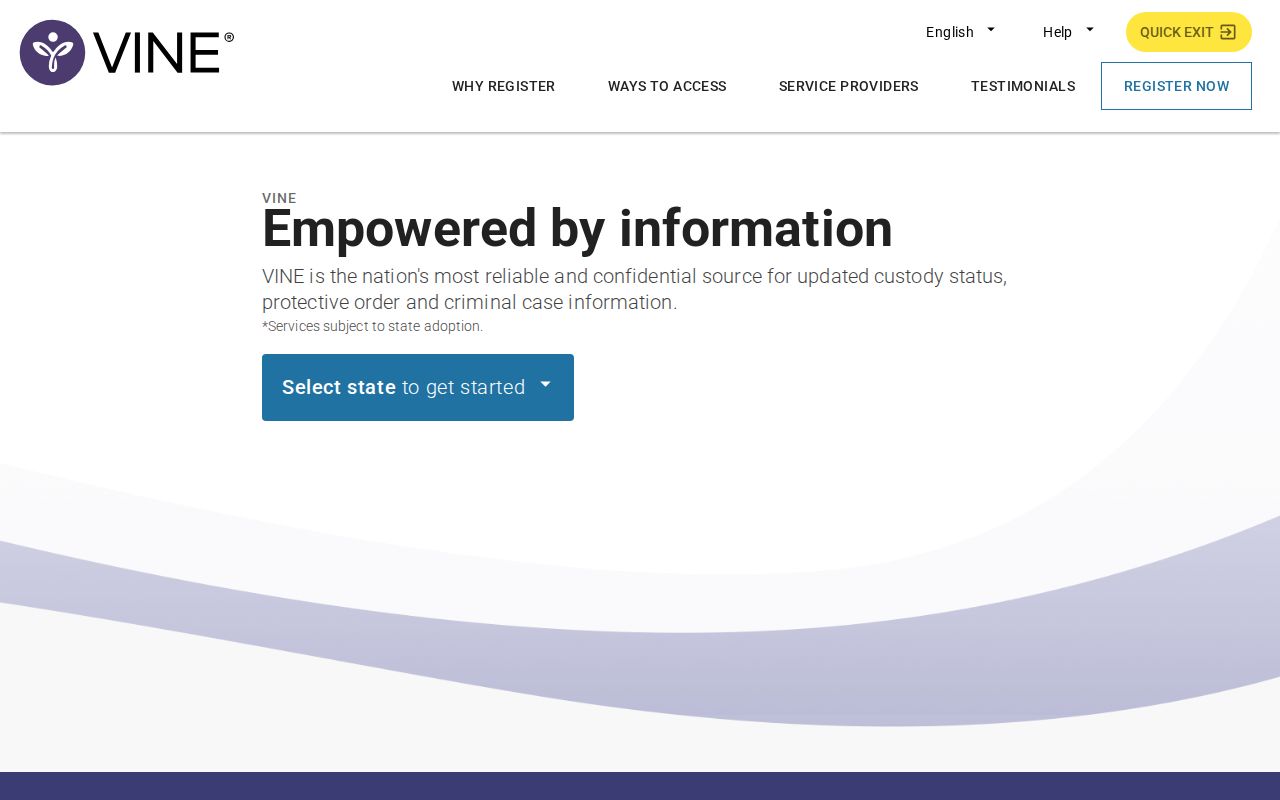
The screen confirms the correct state service, while the selected person's result supplies the agency and custody event that need verification.
Register Kleberg County Release Alerts
Registration begins from the correct person's record. VINELink advertises phone, text, email, and in-app choices where available. Each destination may need its own confirmation. Traditional telephone registration uses a private four-digit PIN; the recipient enters it during an alert call so the service can record receipt. Email or account flows may instead require a link or account confirmation. Do not assume every channel follows the telephone PIN process.
- Select the notification or registration action on the matched source record.
- Choose one of the delivery channels offered by the current interface.
- Enter and confirm the phone number, email address, or account destination.
- Create and retain a PIN when the telephone workflow requests one.
- Save the confirmation, keep contact details current, and register separately when the interface requires it.
Registration does not guarantee delivery. Phone service, spam filters, account settings, delayed agency data, or movement into a different system can interrupt an alert. VINELink lists a Customer First Center at 1-866-277-7477 for service help. A user should recheck the source record and the responsible custodian when an expected message does not arrive.
Confirm Kleberg County VINE Releases
When KCSO is the source and the result says released or out of custody, record the event time and compare it with the sheriff's rolling 48-hour released roster. That official list shows a release timestamp, booking timestamp, booking number, charges, bond, photo, and profile link. Once the rolling card expires, contact the detention center and request the existing booking and release sheet. Court records can explain bond, dismissal, sentence, or commitment, but the jail event record is stronger proof of physical exit time.
A TDCJ source requires a different check. The statewide offender search concerns current state incarceration, while a former prisoner's actual release or discharge belongs in TDCJ incarceration history or a Public Information Act response. A federal source goes to BOP, and present immigration detention goes to ICE. Neither federal system should be inferred from a Texas VINE no-result.
- Release
- The named custodian reports that physical custody ended.
- Transfer
- One custodian handed the person to another; it is not necessarily freedom.
- Discharge
- The sentence or supervision obligation ended, not merely confinement.
- Notification
- An automated lead reporting a source event, which still needs confirmation.
Kleberg County VINE History
The sheriff's archived website promoted VINE as a round-the-clock path for custody-status changes and criminal-case information. That historical local reference shows the service was familiar in Kleberg County, but it does not prove that every present jail event is transmitted or that old interface instructions still apply. The current Texas VINELink portal is the operative search and registration route.
This distinction protects against stale directions. Use the live portal's current buttons and channel choices, then corroborate the result with its named reporting custodian. A KCSO event belongs with the detention center record; a TDCJ event belongs with state corrections. An alert is valuable because it prompts a timely check, not because it replaces the source document.
Note: Keep the VINELink confirmation and reporting-agency name together so a later county, state, or federal check follows the right custody system.