
Kleberg County Parole and Probation
A person outside the Kleberg County Detention Center may still have legal duties. Parole is conditional release from a Texas prison sentence. Mandatory supervision is another state release mechanism, governed by eligibility rules and a Board decision in many cases. Both are administered in the community by the Texas Department of Criminal Justice Parole Division. The Texas Board of Pardons and Paroles makes the parole-related decision, but it is not the person’s day-to-day field supervision office.
Probation, formally called community supervision in Texas, is imposed by a court. Kleberg County Community Supervision and Corrections Department, or CSCD, handles local adult supervision. Someone can receive probation instead of confinement, after a short jail term, or as part of a later court order. A county bond release is different again. It ends the present jail hold but does not, by itself, place a person on parole or prove a probation order.
| Point | Parole or mandatory supervision | County probation |
|---|---|---|
| Source | Release from a TDCJ sentence | Order from the criminal court |
| Decision authority | Texas Board of Pardons and Paroles under applicable law | The court handling the Kleberg County case |
| Supervising agency | TDCJ Parole Division | Kleberg County CSCD |
| Best proof | Board Action plus release and supervision records | Judgment, docket, and current CSCD confirmation |
| End point | Final discharge or other formal termination | Court or CSCD record showing completion or termination |
- Parole
- Conditional community release before the full prison sentence has discharged.
- Probation
- Court-ordered community supervision, also called community supervision in Texas.
- Discharge
- The formal end of the sentence or supervision duty, not merely release from a cell.
- Absconder
- A supervised person alleged to have stopped reporting or complying.
Verify Kleberg County Release Supervision
Start with the release mechanism, not an assumption based on the charge. A person leaving the county jail after bond may have a pending case but no supervision order yet. A person transferred from Kleberg County to TDCJ remains confined. A person physically released from TDCJ may be on parole or mandatory supervision. The source record should establish which path applies.
- Confirm identity and custody path. Use the Kleberg County court case, jail release record, or TDCJ identifier. Similar names require added care.
- Read the controlling record. Look for a court judgment or probation order in a county case. For a state case, seek the Board Action and later release record.
- Choose the right office. Contact Kleberg County CSCD for ordinary local probation. Use the TDCJ Parole Division office route for parole or mandatory supervision.
- Ask precise status questions. Request confirmation of current supervision, office assignment, discharge, or the public status of a warrant or revocation process.
- Corroborate custody changes. A VINE notice can flag a move, but the supervising office and originating custodian remain the sound sources.
The statewide offender search is limited to people currently incarcerated in TDCJ and is at least a day old. Once a former prisoner drops from that live search, request incarceration history, actual release information, and supervision details from TDCJ. The fuller release-record path is also covered on the Kleberg County released-inmate search.
Kleberg County Probation Office Details
Kleberg County has its own Community Supervision and Corrections Department. That local structure matters because county probation questions do not belong with the state parole board. The department’s official site describes local programs and contact routes, while the county clerk identifies the probation telephone line.
Kleberg County CSCD
725 E. Yoakum
Kingsville, TX 78364-1191
Phone: 361-595-8558
Fax: 361-595-8560
Ask the department to distinguish an active supervision term from a closed or discharged case. Court records can show the judgment, later modification, motion to revoke, or termination order. They may not show the field office’s most recent reporting status. Likewise, an office statement about supervision does not replace the court’s judgment when the exact sentence terms matter.
Question: Is every released Kleberg County person assigned to CSCD? No. Bond releases may have only court conditions, state prison releasees may report to TDCJ Parole Division, and people who completed a sentence may have no supervision at all.
Note: The supervising office depends on the release mechanism and judgment, not simply on where the person was arrested or booked.
Kleberg County State Parole Office
Kleberg County state releasees are assigned through TDCJ Parole Division Region IV. The official district listing identifies the Corpus Christi District Parole Office as the relevant state office. It serves parole and mandatory-supervision cases. It does not manage a person released only on county bond or a routine Kleberg County probation order.
Corpus Christi DPO (DRC)
422 Sunbelt Drive
Corpus Christi, TX 78408
Phone: 361-888-5698
Fax: 361-906-3311
The TDCJ Parole Division directory helps confirm office assignments. The official directory view below demonstrates the statewide office-finder path.
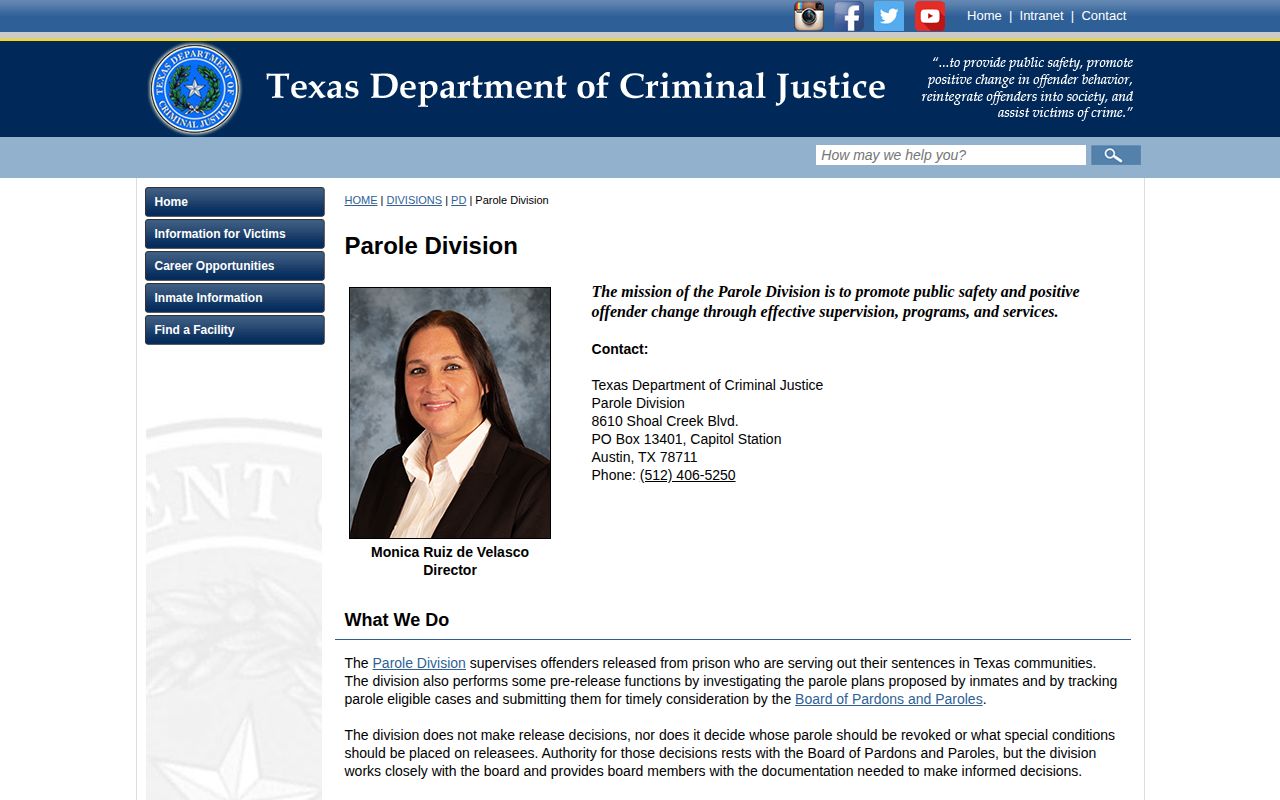
Use the district listing with the release and supervision record because office assignments can change. A current field-office confirmation is stronger than an old address copied from a past record.
Kleberg County Parole Review Records
Texas does not use a public courtroom-style hearing calendar for ordinary parole or mandatory-supervision reviews. The Board says these matters receive administrative file review rather than a formal public hearing. TDCJ identifies eligible cases, an Institutional Parole Officer prepares the case, and a three-member panel reviews the file in sequence. Two concurring votes decide the result.
The published timing is a preparation schedule, not a promised release day. Parole Division identifies an initial-review case about six months before eligibility and a later review about four months before its review date. A current TDCJ detail may show last decision, decision date, or next review. The BPP panel-review explanation confirms the lack of a formal hearing, while the review-process page describes the file-vote sequence.
Eligibility under Texas Government Code sections 508.145 and 508.149 creates an opportunity for review, not a right to release. An approval can also require a program or condition before physical release. Seek the exact vote code and Board Action, then check the later release event. Never turn a favorable review into a claimed release date.
Kleberg County Supervision Warrants
An alleged violation does not erase the prior release. It can begin a new process. The supervising agency may investigate, issue or seek a warrant, impose an intermediate response, or pursue revocation. A person with an active warrant may not yet be in physical custody. Once it is executed, a jail hold may appear while the Board or court addresses the case.
TDCJ does not publish a complete, name-searchable parole-absconder list. Ask the correct office to separate current supervision, warrant status, execution of the warrant, a pending revocation matter, intermediate-sanction placement, revocation, and final discharge. For local probation, the Kleberg County court docket may show a motion or warrant, but the docket should be checked against CSCD and current custody sources.
- A reported failure to report is not a final revocation finding.
- A warrant is not proof that the person is now jailed.
- A jail booking after release may concern a new case or a supervision matter.
- Revocation returns the case to custody or court control under a formal process.
- Discharge means the supervision duty has ended.
Note: Use current office and custody records because an old absconder reference can remain online after the status changes.
Kleberg County Supervision Discharge
Physical release and legal discharge are separate events. Someone can leave TDCJ and continue serving the sentence under parole or mandatory supervision. Someone on probation may remain under a court order long after a county-jail booking has vanished from the sheriff’s rolling release list. The end of that obligation needs its own record.
For state supervision, request public records that identify the supervision start and discharge date, release type, Board Action, and supervising-office information. TDCJ’s Public Information Act route can provide a stronger documentary response when a live lookup no longer shows the person. For county probation, use the judgment and later court orders, then confirm completion with Kleberg County CSCD.
Texas Government Code chapter 552 governs requests for public information, but it does not make every part of a corrections file open. Privacy law, juvenile rules, court orders, and law-enforcement exceptions can require redaction or withholding. Ask for existing records and a written legal basis if access is denied. That keeps the request tied to the actual supervision event rather than a new narrative created by the office.